LaNet-vi
Large-scale network visualization by k-core decomposition.
LaNet-vi draws large networks so that their structure is readable at a glance: nodes are placed in concentric rings by their k-core (or k-dense, or d-core) index, the densest core at the center, with node size following the degree and colors following the index. It is the Python version of the C++ LaNet-vi that produced the well-known Internet AS-level maps (Alvarez-Hamelin, Dall'Asta, Barrat & Vespignani, NIPS 2005; Beiró, Alvarez-Hamelin & Busch, New J. Phys. 2008), and since 5.1.0 it follows the original algorithms.
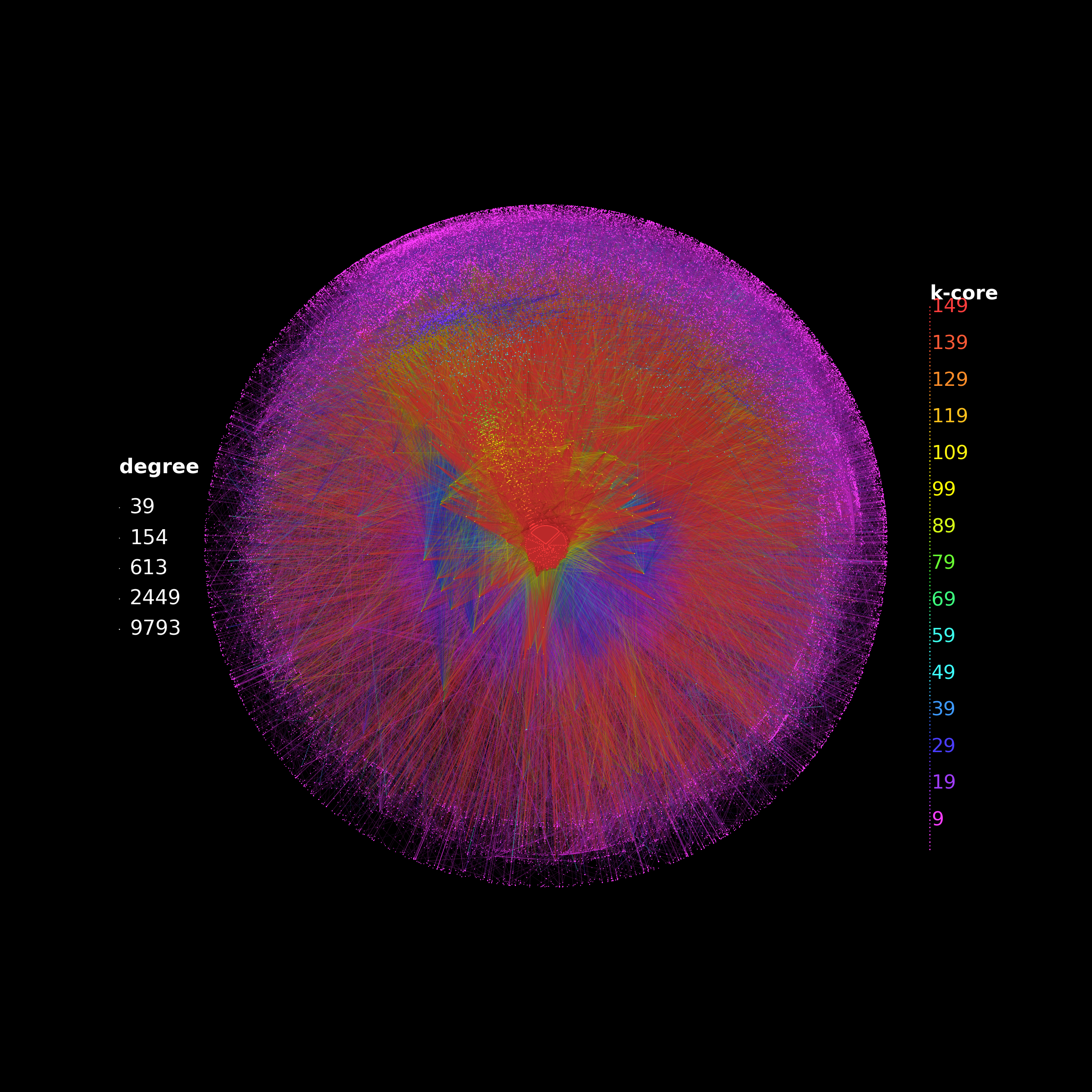
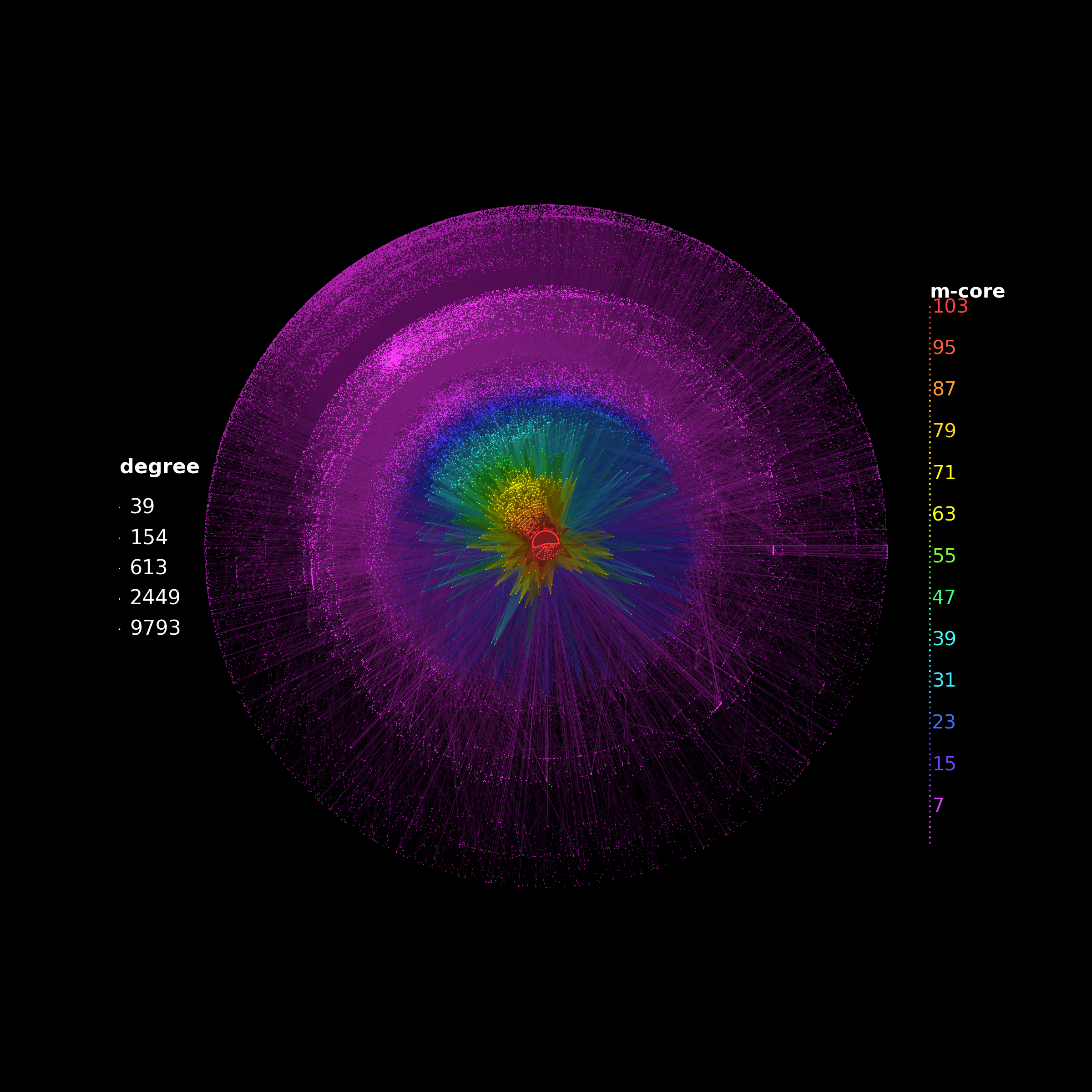
The Internet at the AS level (CAIDA AS relationships, October 2025: 78,370 ASes,
489,407 links). Left: k-cores 1–149, Tier-1 and hypergiant networks in the red core.
Right: k-denses (m-cores), the triangle-based decomposition.
Installation
pip install lanet-vi
Python 3.10 or newer. The package installs the lanet-vi command.
Quick start
An edge list is a text file with one edge per line, source target (and an optional
weight as third column):
lanet-vi visualize --input network.txt --output network.png
The same from Python:
import networkx as nx
from lanet_vi import LaNetConfig, Network

G = nx.Graph(nx.karate_club_graph().edges())
net = Network(G, LaNetConfig())
net.decompose()
net.visualize("karate.png")
Where to go next
- Usage guide — every CLI option, the configuration file, the input and output formats, the Python API step by step.
- Visualization guide — how the picture is built: placement, colors, sizes, edges, legends.
- Concepts — k-cores, weighted k-cores, k-denses, d-cores, and the papers behind them.
- Coming from the C++ LaNet-vi — the flag translation for users of LaNet-vi 3.x and what differs.
- API reference — generated from the docstrings.
- Examples — the CAIDA scripts behind the pictures above.
Citing
If LaNet-vi is useful in your research, please cite the papers that introduced the
method and the software (see CITATION.cff
for a machine-readable version):
- J. I. Alvarez-Hamelin, L. Dall'Asta, A. Barrat, A. Vespignani. Large scale networks fingerprinting and visualization using the k-core decomposition. NIPS 2005.
- M. G. Beiró, J. I. Alvarez-Hamelin, J. R. Busch. A low complexity visualization tool that helps to perform complex systems analysis. New J. Phys. 10 (2008) 125003.
Heritage and license
LaNet-vi 5.x is a from-scratch Python rewrite, MIT-licensed. The original C++ LaNet-vi was developed since 2005 by Mariano G. Beiró and J. Ignacio Alvarez-Hamelin (Universidad de Buenos Aires / CONICET) together with Alain Barrat, Luca Dall'Asta and Alessandro Vespignani; its releases are on SourceForge under the Academic Free License 3.0. The README has the full credits and the relation between the two licenses.